A measurement needs a clock
STEP 1–3 compared weekly subcutaneous semaglutide 2.4 mg with placebo over 68 weeks in adults with overweight or obesity; STEP-2 included type 2 diabetes.[1]
An endpoint gives a measurement an address in time. It does not, by itself, describe the road to that address. Before asking whether a result represents a lasting experience, decide what would need to last: a measured state, exposure to a treatment, or the ability to observe someone. Those are different continuities. A question about one cannot be answered merely by locating another at the end of a calendar.
Calendar time places observations on a common schedule. Time under observation identifies the stretch for which information could contribute. Time since an event anchors a different comparison, because the clock begins when that event occurs. If an analyst changes the starting point, observations that once appeared simultaneous may occupy different positions in an unfolding process. A meaningful comparison therefore needs both a clear starting point and an explanation of what keeps its clock running.
This matters when ordinary words carry hidden time requirements. Calling something persistent asks about continuity; calling it recurrent asks about a return; calling it resolved asks about a change followed by an adequately defined observation period. None is simply another word for a final measurement. The productive reading question is which feature of time the reported measurement retains. That question can recognize a useful endpoint while reserving judgment about a more demanding temporal description.
What the record keeps
These gastrointestinal analyses were post hoc. Reports included event onset and end dates.[2]
Adverse-event collection included follow-up after treatment ended.[1]
A date pair could support a question about an event's span, provided the dates refer to consistently defined boundaries. To ask about repeated events, the pairs would also need to remain linked to the same person and distinguishable from one another. A summary that retains only how many people reported anything would discard that ordering. This is a distinction between the information a record might contain and the information an analysis chooses to preserve.
Even with dates, an analyst would need to establish what an apparent end means. It could denote an explicitly recorded cessation, the last affirmative report, or another operational boundary. These definitions would answer different questions. If observation stopped before an end could be established, the known span would be incomplete. Treating that unfinished interval as a completed one would add a conclusion that the record had not supplied.
Conversely, uncertainty about a boundary need not erase everything learned before it. An analysis could retain what is known and identify the part that remains unresolved. The important requirement is to keep the uncertainty attached to the temporal claim. A record adequate for establishing that an event was reported might not establish its exact duration. Evaluating adequacy therefore means matching a proposed inference to the required information, rather than declaring a dataset sufficient or insufficient for every purpose.
An endpoint is not a timeline
Read a bar's length as an answer to the quantity named by its label. Reading across bars does not turn their horizontal positions into consecutive stages. A graphic can place categories beside one another without describing movement between them. Recovering movement would require linked observations showing an earlier and a later state for the same individuals. The arrangement of marks on the page cannot substitute for that linkage.
A status classification also leaves its explanation open. Membership in a category and the reason for membership are separate variables. Even if a reason were recorded elsewhere, it would have to be connected to the relevant transition before supporting a claim about why that transition happened. Inferring a reason from a category's name would collapse description and explanation into a single step. A larger category does not repair that missing connection.
The same distinction applies when asking whether an experience ended. A treatment decision and a symptom state need separate definitions and separate observations. Neither logically determines the other. To interpret a status count as evidence of resolution would require a justified relationship between those variables, along with a definition of resolution and a suitable observation period. Without those additional premises, a numerical contrast between statuses remains a contrast in the variable actually classified.
That boundary also protects causal interpretation. Comparing the sizes of categories formed by an eventual status does not establish what would have happened under an alternative treatment choice. Such a question requires a comparison capable of separating the choice from other reasons the outcomes could differ. The display can still make a descriptive distinction easy to see. Its clarity should help readers identify the next question, rather than encourage them to treat every question as already answered.
An endpoint snapshot
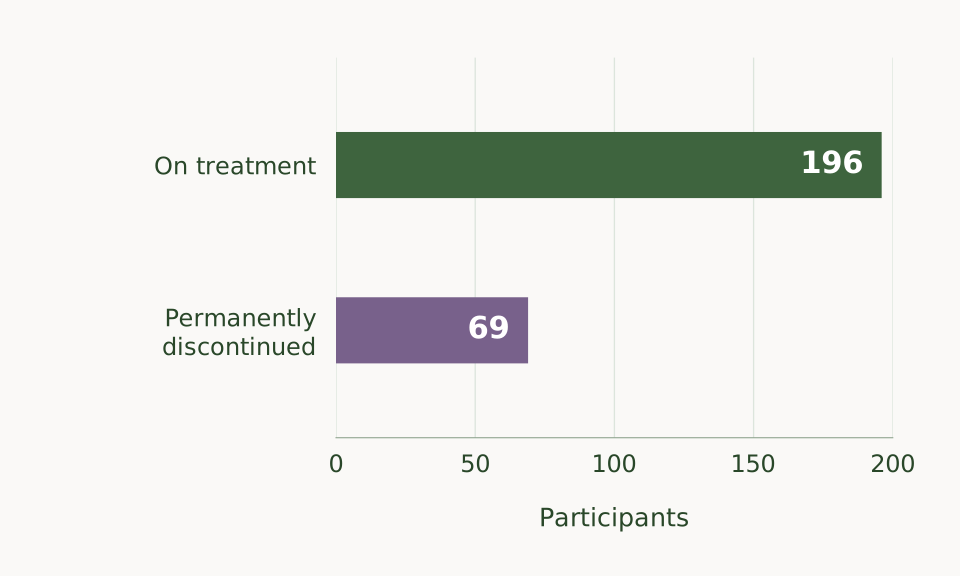
Read the chart as a table
| Status | Participants |
|---|---|
| On treatment | 196 |
| Permanently discontinued | 69 |
Recurrence cannot be read backward
An endpoint is a compression of a sequence. Compression is useful because it reduces many possible details to something comparable, but the reduction can discard distinctions. If separated episodes and an uninterrupted episode could lead to the same final classification, that classification cannot uniquely identify which sequence occurred. This is a logical obstacle, not a statement about the frequency of either pattern in any particular dataset.
To distinguish recurrence from persistence, first define the interval that would separate episodes. A new positive report alone would not establish recurrence if the preceding state remained unknown. Conversely, an explicitly observed interval without the event could matter even if the endpoint were unchanged. The analysis would need a rule for deciding when one episode ends and another begins, and enough observation to apply that rule.
The observation schedule also enters the meaning of a gap. If information were available only at separated occasions, silence between them would not itself establish absence. A claim of continuity would need to specify whether it means continuous observation, repeated affirmative observations, or an analytical assumption about the intervals between observations. Those versions can sound alike in everyday language while making different demands on the evidence.
Even a cumulative duration would not fully restore the sequence. Rearranging the same occupied intervals could preserve their total length while changing their spacing. Combining records across people could further remove who experienced which pattern. A recurrence question therefore needs linked temporal information rather than a more emphatic reading of an aggregate endpoint. Better precision in the final count would reduce uncertainty about that count; it would not recover distinctions the summary was never designed to retain.
The observation window matters
The week-68 descriptive weight analysis required dosing within the previous two weeks.[2]
Whether a measurement belongs in an analysis is a different question from whether it exists. A person could have a recorded outcome yet fail an eligibility rule for a particular calculation. Another could satisfy the rule in principle but lack the required measurement. Keeping these possibilities separate prevents the phrase 'not included' from silently becoming a claim that nothing was known about the person.
A useful way to inspect an analysis is to distinguish treatment status, observation status, and analytical eligibility. Each describes a different relationship between a person and a result. If an inclusion rule selected people partly through events occurring after the start, the included group could differ from the initial group in ways relevant to the outcome. Establishing whether that happened, and how much it mattered, would require information about the selection process rather than an assumption about its direction.
Nor would the mere existence of additional measurements settle which result to calculate. A question about an experience under a specified exposure condition and a question about everyone initially entering a comparison would ask for different sets of information. Neither question should quietly inherit the other's interpretation. The analyst needs to say which population the summary describes and which observations connect that population to the intended time point.
When observations are unavailable, the unresolved issue is what their absence permits one to infer. Missing values cannot establish their own magnitude or the reason they are missing. Any attempt to extend a result beyond the observed information would therefore need assumptions that can be stated and examined.
Interruption changes the question
ICH distinguishes a treatment-effect question from its numerical estimate and requires specifying how treatment discontinuation is handled.[3]
An interruption can occupy different places in a scientific question. If the purpose is to describe an entire course of experience, the interruption may belong within that course. If the purpose concerns an imagined course without interruption, the question asks about something that cannot simply be read from a record after an interruption occurred. The distinction is about the meaning of the answer, before it is about choosing a calculation.
Deleting observations does not create the unobserved alternative course. It creates a smaller set of observations. To interpret that smaller set as answering the imagined question would require a reason to believe the remaining information represents what would otherwise have happened. Similarly, retaining later measurements would describe later measurements; it would not automatically isolate what continuing exposure alone would have produced.
This is why a numerical result cannot define its own scientific target. An analyst could obtain a precise answer while leaving ambiguous which course of experience the answer concerns. Deciding the target first makes it possible to ask whether each analytical step preserves that meaning. The decision should also identify which uncertainty comes from unavailable observations and which comes from assumptions linking observations to an unobserved alternative.
A meaningful sensitivity exercise would then change an assumption that actually carries that link. Repeating a calculation with a cosmetic alteration would offer little reassurance about a disputed premise. If conclusions changed under plausible alternatives, the variation would show where interpretation depends on the premise. If they remained similar, reassurance would extend only to the alternatives examined.
A selected second start
STEP-4 randomized participants after a 20-week run-in, requiring target-dose attainment and continued use; the randomized period lasted another 48 weeks.[4]
A study can have more than one scientifically relevant starting point. Entry identifies a population at the beginning of a process; later eligibility identifies a population that has reached a boundary. A comparison beginning at that boundary asks about what follows it. Treating the two starting points as interchangeable would remove part of the process whose consequences a reader may want to understand.
Random assignment can support comparability between assigned groups at the point where assignment occurs. It does not retroactively assign people to the histories that made them eligible. Nor does it create an observed outcome for people outside that eligibility boundary. A strong comparison within a selected population and uncertainty about its application elsewhere can therefore coexist without contradiction.
Selection also needs to be interpreted according to its actual rule. Satisfying an eligibility condition would establish that condition, not every other desirable state a reader might associate with it. In particular, no logical step turns qualification into a complete account of someone's preceding experience. To understand that experience, an analyst would need measurements directed at it, rather than a more reassuring description of eligibility.
For a question about a different starting population, the next task would be to justify a connection between populations. That would require examining which differences could change the outcome and what information could address them. Simply extending a later comparison backward in time would skip that task. The useful boundary is where the comparison begins, because it determines which part of the process assignment can help explain.
A relationship is not a pathway
Symptom groups were not randomized.[2]
Temporal order is necessary to some causal explanations, but order alone is insufficient. If a proposed intermediary occurred before an outcome, that sequence would leave open whether changing the intermediary would change the outcome. Both could instead depend on another process, or their apparent connection could depend on how observations were obtained. These are alternative logical structures, not claims that any particular mechanism operated.
An argument for a pathway would need to identify what intervention on the proposed intermediary means. Merely comparing people who did and did not report something does not supply that intervention. If the groups differed in other outcome-relevant ways, their contrast would combine those differences with the distinction of interest. Statistical adjustment would help only to the extent that the relevant differences were identified, measured appropriately, and handled under justified assumptions.
Timing can make this problem more demanding. If an earlier outcome influenced a later report, a summary that ignored sequence could be compatible with a different direction of influence. A pathway analysis would need a chronology that rules out the proposed cause occurring after the effect it is supposed to explain. It would also need to address possible shared causes; ordering alone cannot exclude them.
A comparison of averages poses a related but separate problem, explored in the companion analysis of averages. A group summary describes a contrast; a pathway claim explains how a contrast came about. Keeping those tasks distinct allows a descriptive result to remain informative without treating it as a demonstrated mechanism or converting a relationship between groups into a prediction about an individual's sequence.
Who produced the record
Novo Nordisk funded the trials and writing.[2]
Three design-paper authors were employees and shareholders of Novo Nordisk.[1]
Declared interests identify relationships worth keeping visible while evaluating an analysis. They do not provide a numerical amount to subtract from a result. A stronger response is to ask which choices could affect the answer: how an outcome was defined, which observations entered the calculation, and whether alternative choices would address the same question. Scrutiny becomes useful when it attaches to a consequential decision that another reader could inspect.
Checking a published cell against a table can establish consistency of transcription. It cannot independently reproduce the analysis that produced the cell. Reproduction would require the relevant inputs, definitions, and analytical operations. Agreement at the transcription stage and uncertainty at the analytical stage are compatible. Keeping them separate prevents a successful check of one link in the chain from being described as verification of the entire chain.
Transparency should also extend to the publication interpreting the work. Readers can find publisher information and the stated scope of featured provider reviews about this publication. For any scientific interpretation, the substantive test remains whether the reasoning connects the reported measurement to the conclusion through explicit, defensible steps.
Keeping the reading in scope
Wegovy is contraindicated with personal or family medullary thyroid carcinoma history, multiple endocrine neoplasia type 2, or prior serious hypersensitivity to semaglutide or product ingredients. Use is not recommended with severe gastroparesis. Persistent or severe abdominal pain needs prompt assessment; gastrointestinal fluid loss can injure kidneys. Gastric emptying is delayed.[5]
Compounded GLP-1 products are not FDA-approved.[6]
Understanding a research comparison and making a care decision are different tasks. This reading can help identify which question a result answers; it cannot determine what an individual should do with treatment. Use the peptide reference library for reference navigation. For administrative service questions, the CoreAge Rx service review points to a separate kind of documentation that should be checked for its date and current terms. A service description cannot establish trial outcomes, and trial evidence does not verify a provider's present practices.
Reader questions
Does being on treatment mean an experience has resolved?
A treatment-status observation classifies participation or use under its own rule. Resolution classifies an experience under a different rule. To connect the two, an analysis would need a definition of resolution, observations that establish it, and a justified reason the status variable carries that information. The status alone cannot supply those missing premises, even when it is measured precisely and reported clearly.
What would be needed to distinguish recurrence from persistence?
The analysis would need linked observations that establish an episode's boundaries and what happened between episodes. It would also need a rule distinguishing a new episode from continuation of an earlier one. An unobserved interval would have to remain uncertain unless an assumption justified another interpretation. The essential question is whether the evidence distinguishes a return from continuity, rather than merely recording another positive observation.
Can an endpoint still be useful when it leaves the journey unclear?
Yes, if its usefulness is stated at the level it supports. An endpoint can describe a defined state without establishing how that state developed. A reader can use the description to formulate a further question about timing, duration, or explanation. The next analysis should preserve the information that further question requires. Rejecting an endpoint because it cannot reconstruct a whole sequence would confuse a bounded answer with an unsuccessful one.
What to take from the evidence
A good reading follows the inferential steps in order. First establish what a measurement describes and which observations contribute to it. Then ask whether the temporal claim under consideration requires distinctions that the summary preserves. If several sequences remain compatible with the same endpoint, the next question concerns linked timing information. If a comparison begins only after an eligibility boundary, the next question concerns its connection to a different starting population. If a relationship is offered as an explanation, the next question concerns the alternative causal structures still compatible with it. These are different gaps and need different evidence. Recognizing them lets a result retain its descriptive value while making any broader interpretation accountable to the additional information and assumptions it requires.
Scope of this article
This article offers editorial scientific interpretation for general education, not individualized care advice or clinician review. It does not independently reproduce participant-level analyses. Its reasoning distinguishes questions that a summary can answer from questions requiring additional observations or assumptions; it cannot establish an individual's future course.